RDF Statements
RDF is based on statements made about resources. A resource is anything with an associated URI, and a statement describes the properties of resources. A property in RDF is a special kind of resource, which describes a relationship between resources.
RDF uses a triple to link a subject to an object via a predicate. Note that RDF only allows statements consisting of a single subject and a single object.
Subject: The resource that the statement describes (e.g. a person, place, object, document, etc.). Represented in diagrams as an oval.
Predicate: The property of the subject (e.g. name, city, colour, characteristic). Represented in diagrams as an arrow.
Object: The value for the property of the subject (e.g. John, red, 64, etc.). Can be either a resource or a literal value. Represented in diagrams as a rectangle.
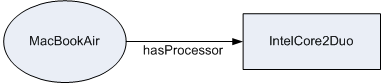
For example, the statement "The MacBookAir has an IntelCore2Duo processor" can be split into its three components:
- The subject MacBookAir
- The predicate hasProcessor
- The object IntelCore2Duo
This can then be represented diagrammatically as:
Each triple is defined by a single rdf:Description element, and the subject is defined by the rdf:about attribute. Within the tags is the property-value pair, corresponding to the predicate and object of the triple. The predicate in this example is identified by the name of the element computer:hasProcessor, and the object IntelCore2Duo appears inside the element. e.g.
<rdf:Description rdf:about="MacBookAir">
	<computer:hasProcessor>IntelCore2Duo</computer:hasProcessor>
</rdf:Description>